


Solid Core Doors vs Hollow Core Doors: Which is Best for Fire Safety?
The short answer is clear: when comparing solid core doors vs hollow core doors for fire protection capability, high-density core doors generally provide better fire resistance, structural stability, and long-term performance. lightweight core doors may work for light residential use, but they are usually not suitable for high fire-rating requirements or commercial applications.
In commercial buildings and public spaces, fire doors are part of a complete passive fire protection system. The choice between high-density core doors vs lightweight core doors affects fire rating, durability, acoustic insulation, and long-term maintenance costs. Because door core construction directly impacts fire performance, selecting the right door type is important for both safety compliance and project efficiency.
What is a Solid Core Door?
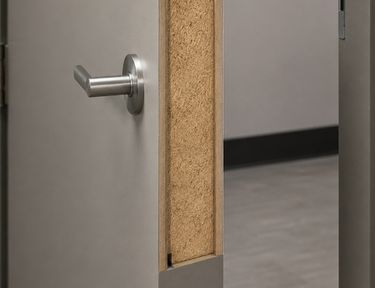
A solid core door is constructed with a dense internal core material instead of an empty interior. Common core materials include engineered timber, mineral cores, particleboard, or composite fire-resistant materials.
In the context of solid construction doors vs lightweight core doors, solid core models are known for their strength and improved fire performance. Their dense structure slows heat transfer and helps maintain door integrity during fire exposure.
Many fire-rated wooden doors use mineral or composite cores because these materials can achieve higher fire resistance level while still allowing decorative finishes.
Typical solid core materials include:
- Mineral core
- Engineered timber core
- Particleboard core
- Composite fire-resistant core
Each material affects fire performance, weight, acoustic insulation, and overall project cost differently.
Compared with hollow designs, solid construction doors are also more resistant to impact and daily wear. Another advantage is acoustic insulation. Due to the heavier internal structure, high-density core doors typically reduce sound transmission more effectively than hollow core doors. This makes them popular in hotels, offices, hospitals, and educational facilities.
Industry testing consistently shows that denser door cores improve structural stability under high temperatures. Fire-rated assemblies tested under UL 10C or BS 476 standards often rely on solid core construction to maintain performance throughout the required rating duration.
What is a Hollow Core Door?
A hollow core door uses a lightweight internal structure, often made with cardboard honeycomb or thin support grids between surface panels. Although called “hollow,” these doors are not completely empty inside.
In the comparison of fire-rated solid doors vs lightweight core doors, hollow core models are mainly valued for their lower cost and lighter weight. They are commonly used in interior residential applications where fire resistance is not the primary concern.
Because hollow core doors contain less dense material, they are generally easier to transport and install. This can reduce labor costs in small-scale projects.
However, the lightweight structure also creates limitations. hollow interior doors typically offer lower impact resistance, reduced acoustic insulation, and weaker fire performance compared with fire-rated solid doors.
In many commercial projects, hollow interior doors cannot meet strict fire-rating requirements unless specially reinforced and tested as part of a certified fire door system.
Fire Safety Comparison: Solid vs Hollow Core
The biggest difference in solid wooden fire doors vs hollow interior doors is fire resistance performance. Reinforced core doors generally perform better because their dense internal materials slow down heat penetration and structural failure.
By contrast, hollow interior doors can deteriorate more quickly under high temperatures due to thinner construction and internal air gaps. This affects their ability to maintain integrity during a fire event.
The table below summarizes the key differences:
| Feature | Solid Core Doors | Hollow Core Doors |
|---|---|---|
| Fire Resistance | Higher | Lower |
| Structural Strength | Stronger | Weaker |
| Acoustic Insulation | Better | Limited |
| Weight | Heavier | Lighter |
| Cost | Higher | Lower |
| Typical Applications | Commercial / Fire-rated | Residential Interior |
Another important factor is smoke control. Fire-rated solid doors often provide tighter sealing performance when paired with fire-rated seals and hardware. This helps reduce smoke spread during emergencies.
Key performance differences often include:
- Heat resistance under fire exposure
- Smoke containment capability
- Structural stability at high temperatures
- Long-term durability in high-traffic areas
These factors are especially important in commercial and public buildings where fire safety compliance is critical.
Testing data from multiple fire-door certification systems shows that door density and construction quality significantly influence fire endurance. In practical terms, this means that reinforced core doors vs hollow interior doors is not only a cost discussion but also a life-safety decision.
That said, basic interior doors may still be appropriate in low-risk residential areas where building codes do not require certified fire-rated assemblies.
Which Door Type Should You Choose?
Choosing between reinforced core doors vs low-density door structures depends on building type, fire regulations, project budget, and performance expectations.
For Commercial or Public Buildings
Commercial buildings usually require stricter fire protection measures. Offices, hospitals, hotels, schools, and retail facilities often need certified fire-rated doors that can withstand fire exposure for a specified duration.
In these environments, solid wooden fire doors are typically the preferred option because they provide better fire resistance, durability, and long-term reliability.
Heavier traffic levels also make structural strength important. Solid wooden fire doors generally perform better under frequent daily use and repeated opening cycles.
For Light Residential Applications
low-density door structures may still be suitable for certain residential interior spaces where fire resistance level are not required. Bedrooms, closets, or utility rooms in low-risk environments often use hollow core construction due to lower cost and lighter weight.
For homeowners prioritizing affordability, low-density door structures can provide acceptable functionality in non-critical areas. However, they are usually not recommended for locations where enhanced fire resistance performance is required.
Some residential projects also combine both types, using solid core fire-rated doors in critical areas and basic interior doors elsewhere to balance cost and performance.
Key Decision Factors
When evaluating reinforced core doors vs basic interior doors, several factors should be considered:
- Required fire rating
- Building code compliance
- Durability expectations
- Acoustic insulation needs
- Project budget and lifecycle cost
It is also important to evaluate the complete fire door assembly, including frame, seals, hinges, and hardware. Even a high-quality high-density core doors may fail compliance if paired with incompatible components.
From a long-term perspective, choosing the correct door type early in the design phase can reduce maintenance issues and replacement costs later.
Conclusion
When comparing solid core doors vs hollow core doors, solid core doors are generally the better choice for fire resistance performance, durability, and commercial performance. Hollow core doors still have value in light residential applications, but they are usually less suitable for projects requiring certified fire protection.
The right decision depends on fire-rating requirements, building usage, and long-term project goals. For contractors and developers seeking reliable fire-rated wooden door solutions, working with an experienced manufacturer can help ensure both compliance and cost efficiency.
Old To New provides customized fire-rated wooden door systems designed for commercial and architectural projects, helping clients achieve the right balance between safety, performance, and design flexibility.

Contact
Beyond Protection, There's Peace of Mind.
© 2024 oldtonew Powered by ShopAstro