


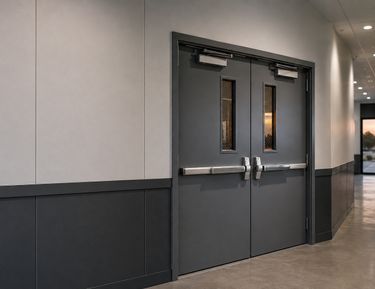
How to Choose Fire and Smoke Doors for Commercial Buildings
Choosing the right fire and smoke doors for commercial buildings requires more than selecting a door with a fire label. The correct specification depends on fire rating requirements, smoke-control performance, occupancy risks, certification standards, and door construction details. A properly selected system can improve evacuation safety, support code compliance, and reduce the risk of failed inspections or costly replacements later in the project.
In modern commercial construction, smoke-rated fire doors are no longer treated as standalone products. They are part of a larger passive fire protection strategy designed to control flame spread, limit smoke migration, and maintain safer evacuation routes during emergencies. Understanding how to choose fire and smoke doors correctly is essential for architects, contractors, developers, and procurement teams involved in commercial projects.
What Should Be Evaluated Before Specifying Fire and Smoke Doors?
Before specifying fire and smoke doors for commercial buildings, project teams should first evaluate the building’s safety objectives, occupancy type, and regulatory requirements. Different projects require different levels of protection depending on how occupants use the building and how evacuation procedures are designed.
For example, a healthcare facility may require stricter smoke-control performance because patients often need additional evacuation time. Office buildings may prioritize compartmentation between occupied areas, while hotels usually require smoke-resistant assemblies along guestroom corridors and protected stairwells.
The specification process should also consider how the door assembly interacts with the building’s overall smoke management and passive fire protection strategy. A certified door slab alone is not enough if the frame, seals, hardware, or installation method are incompatible with the tested system.
Several early-stage evaluation points are especially important:
- Required fire rating duration
- Smoke leakage performance requirements
- Building occupancy classification
- Local code and certification standards
- Long-term maintenance considerations
Industry standards such as UL 1784, UL 10C, EN 1634-1, and EN 1634-3 are commonly referenced when evaluating smoke-control and thermal protection performance in commercial applications.
5 Key Factors That Determine the Right Fire and Smoke Door for a Project
Selecting the right fire and smoke doors involves balancing compliance requirements, building functionality, safety expectations, and budget considerations. The following factors are among the most important during project planning and specification.
1. Required Fire Rating
The first step in learning how to choose smoke-rated fire doors is understanding the required fire rating. Commercial projects commonly use 30, 60, 90, or 120-minute rated assemblies depending on building design and compartmentation strategy.
Higher fire endurance level are usually required in high-risk or high-occupancy areas such as stairwells, plant rooms, storage spaces, and protected escape routes. Lower ratings may still be acceptable in certain internal corridors or low-risk partitions depending on local building regulations.
However, selecting the highest fire endurance level is not always necessary. Over-specifying assemblies can increase procurement costs, installation complexity, and door weight without improving practical safety outcomes in every location.
Project teams should verify:
- Required rating by occupancy type
- Local code requirements
- Compatibility with wall systems
- Certified test documentation
- Operational functionality after installation
Understanding the relationship between fire endurance requirements and actual building use helps avoid unnecessary specification costs.
2. Smoke Control Requirements
Smoke-control performance is equally important in many commercial environments. During building fires, smoke often spreads faster than flames and can quickly compromise evacuation routes.
Smoke-sealed fire doors for commercial buildings are typically tested under pressure conditions such as 25Pa to evaluate smoke leakage performance. These tests help determine whether the assembly can effectively limit smoke movement between compartments during emergency conditions.
Proper smoke containment depends on multiple components working together, including seals, thresholds, frame tolerances, glazing systems, and hardware compatibility. Even small gaps can significantly reduce performance if installation quality is poor.
Projects involving hospitals, hotels, underground facilities, and high-rise buildings often require stronger smoke isolation performance because evacuation procedures may take longer or involve higher occupant density.
3. Building Occupancy and Evacuation Risk
Different commercial buildings present different evacuation risks. Occupancy type strongly affects how fire and smoke door systems should be specified.
In healthcare projects, patients may require assisted evacuation, meaning smoke compartmentation becomes especially important. Educational buildings often prioritize corridor protection and controlled evacuation flow, while office environments may focus on protecting meeting spaces, stairwells, and central circulation areas.
Hotels and residential towers also require careful smoke isolation performance planning because sleeping occupants may not immediately detect emergency conditions. In these environments, properly tested assemblies help maintain safer escape paths and reduce smoke migration between compartments.
The higher the occupancy density and evacuation complexity, the more important properly certified smoke barrier protection systems become.
4. Applicable Standards and Certifications
One of the most common specification mistakes is assuming all fire-rated products follow the same testing standards. In reality, certification requirements vary significantly between regions and building codes.
Commercial projects in North America commonly reference UL standards, while European projects often follow EN testing frameworks. Some projects may also require local certifications or third-party inspection documentation before approval.
Project teams should carefully verify:
| Certification Area | Common Standards |
|---|---|
| Fire Resistance | UL 10C / EN 1634-1 |
| Smoke Leakage | UL 1784 / EN 1634-3 |
| Hardware Compliance | ANSI / BHMA / CE |
| Self-Closing Performance | EN 1154 |
Using uncertified substitutions during procurement can invalidate the tested assembly and create inspection risks later in the project.
From a compliance perspective, authorities generally evaluate the performance of the complete tested system rather than individual components alone.
5. Door Materials and Construction
Door material selection directly affects durability, smoke barrier protection capability, acoustic performance, maintenance requirements, and overall project cost.
Commercial fire and smoke door systems are commonly manufactured using timber-based cores, mineral core structures, composite fire-resistant materials, or steel-reinforced assemblies depending on the project environment.
Dense-core constructions often provide stronger thermal stability and improved acoustic performance, while steel systems may offer higher impact resistance in industrial or high-traffic environments. Material selection should balance safety performance with aesthetics, operational requirements, and maintenance expectations.
Several construction factors influence long-term performance:
- Core density and structure
- Edge sealing systems
- Hardware reinforcement
- Surface finish durability
- Frame compatibility
Because commercial doors experience repeated daily use, durability and operational stability are often just as important as fire certification itself.
Cost vs Compliance: Should You Always Choose the Highest Specification?
Many buyers assume that selecting the highest specification automatically guarantees the best outcome. In practice, the most effective specification is usually the one that matches actual building requirements without unnecessary overengineering.
Higher-rated smoke-sealed fire doors often involve thicker cores, heavier hardware, more advanced sealing systems, and more complex installation procedures. While these features may be necessary in high-risk areas, they may not provide meaningful additional value in lower-risk spaces.
Over-specification can increase:
- Procurement costs
- Installation labor requirements
- Maintenance complexity
- Hardware replacement expenses
- Long-term operational weight issues
Instead of simply choosing the highest available specification, project teams should focus on selecting certified assemblies that align with occupancy risks, code requirements, and evacuation strategies.
Common Procurement Mistakes When Selecting Fire and Smoke Doors
Many commercial projects experience delays because of procurement decisions made without fully understanding compliance requirements. One of the most common problems is purchasing products based only on price while overlooking certification compatibility.
Another frequent issue involves mixing components from different manufacturers without verifying whether the assembly was tested as a complete system. Even if individual parts appear compliant, incompatible combinations may fail inspection.
Additional procurement mistakes include:
- Choosing doors without verified smoke leakage testing
- Omitting required smoke seals
- Using non-certified hardware substitutions
- Ignoring installation tolerances
- Failing to coordinate with inspectors early in the project
Proper communication between suppliers, architects, contractors, and code consultants can significantly reduce these risks. Early specification review often helps avoid expensive corrections during final inspection stages.
Conclusion
Understanding how to choose smoke-rated fire doors is essential for maintaining compliance, improving evacuation safety, and supporting long-term building performance in commercial projects. The right specification depends on balancing fire endurance requirements, smoke isolation capability, occupancy risks, tested certifications, and construction durability.
Rather than focusing only on the highest specification, project teams should prioritize selecting fully tested assemblies that match the building’s actual operational and safety requirements. Proper specification early in the design process can help reduce inspection failures, project delays, and unnecessary replacement costs later.
Old To New provides customized fire and smoke doors for commercial buildings, helping architects, contractors, and developers achieve reliable smoke-control performance, certified compliance, and flexible design integration for modern construction projects.

Contact
Beyond Protection, There's Peace of Mind.
© 2024 oldtonew Powered by ShopAstro