


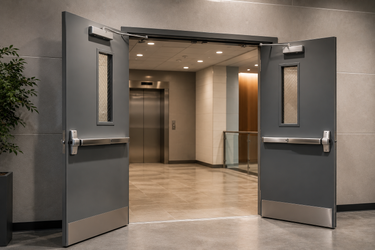
Fire Resistance vs Thermal Insulation: Understanding the Key Differences in Fire Door Performance
Many buyers assume that a door with strong thermal insulation automatically provides better fire protection. In reality, fire resistance and thermal insulation are related but technically different performance characteristics. A fire door may achieve a high fire rating without offering excellent heat-transfer control, while some insulated fire doors are optimized more for energy efficiency than extended fire endurance.
Understanding the difference between fire resistance vs thermal protection performance is essential for architects, contractors, developers, and specification teams working on modern commercial projects. Choosing the correct balance between these two properties can improve occupant safety, building energy performance, smoke containment, and long-term operational efficiency.
As commercial buildings increasingly focus on both life safety and sustainability, thermal insulation fire doors are becoming more important in offices, hotels, hospitals, schools, and public infrastructure projects. Modern door systems are now expected to support passive fire protection while also helping reduce heat loss, improve indoor comfort, and lower overall building energy consumption.
Fire Resistance and Thermal Insulation: What Is the Difference?
Although these terms are often discussed together, fire resistance and thermal insulation measure different aspects of fire door performance. One focuses on surviving fire exposure, while the other focuses on controlling heat transfer.
Fire resistance evaluates how long a door assembly can maintain structural integrity and resist flame penetration during a fire. Thermal insulation measures how effectively the door reduces heat transmission between two sides of the assembly.
The table below highlights the key differences:
| Performance Type | Fire Resistance | Thermal Insulation |
|---|---|---|
| Main Purpose | Resist flames and heat exposure | Reduce heat transfer |
| Typical Measurement | 30/60/90/120 minutes | U Value (W/m²·K) |
| Key Standards | UL 10C / EN 1634-1 | Thermal performance testing |
| Primary Focus | Life safety & compartmentation | Energy efficiency & comfort |
| Important in Fire Situations | Yes | Indirectly |
| Important in Daily Building Operation | Limited | Very important |
Modern building regulations increasingly encourage combining passive fire protection with energy-efficient construction practices. Because of this, insulated fire doors are becoming more common in commercial developments where both safety and sustainability targets are required.
What Fire Resistance Means for Fire Doors
Fire resistance refers to a fire door’s ability to withstand direct fire exposure for a specified period without structural failure. During testing, the door assembly is exposed to controlled high temperatures to evaluate whether flames, smoke, and heat can penetrate through the system.
Commercial projects commonly require 30, 60, 90, or 120-minute rated assemblies depending on building occupancy, compartmentation strategy, and evacuation risk. Higher fire ratings are often used in stairwells, plant rooms, escape corridors, and high-risk service areas.
A fire-resistant door system is not only the door leaf itself. Performance depends on the entire tested assembly, including:
- Door core construction
- Frame compatibility
- Smoke seals
- Fire-rated hardware
- Self-closing systems
- Glazing components
If any component is replaced with a non-tested alternative, the certified fire performance of the assembly may be compromised. This is one reason many commercial projects fail inspection despite using fire-rated products.
Modern testing standards such as UL 10C and EN 1634-1 evaluate integrity under extreme thermal conditions. These standards help verify whether the assembly can maintain compartmentation long enough to support safer evacuation and emergency response procedures.
What Thermal Insulation Means for Fire Doors
Thermal insulation refers to a fire door’s ability to reduce heat transfer between indoor and outdoor environments or between separate building compartments. In simple terms, it measures how effectively the door slows the movement of heat through the assembly.
This performance is commonly expressed using a U Value, which measures heat flux through a material layer. Lower U Values indicate stronger insulation performance and reduced heat transfer.
According to thermal protection fire door testing data, some high-performance systems can achieve thermal insulation coefficients as low as 1.0–1.2 W/m²·K, while standard LVL multi-layer structural doors may range between 1.5–1.9 W/m²·K. Lower thermal conductivity generally contributes to better energy efficiency and improved indoor climate stability.
Thermal insulation fire doors are increasingly used in projects where building energy performance matters alongside safety compliance. These applications commonly include:
- Hotels and hospitality buildings
- Office towers
- Healthcare facilities
- Educational campuses
- Mixed-use commercial developments
Why Thermal Insulation Matters Beyond Energy Savings
Good insulation performance does more than reduce heating and cooling costs. It also helps stabilize indoor temperatures, improve occupant comfort, and reduce long-term energy demand.
In modern sustainable construction, insulated fire doors may contribute to:
- Reduced HVAC energy consumption
- Improved indoor thermal comfort
- Better environmental performance
- Lower building carbon emissions
- Enhanced acoustic separation in some designs
Buildings with poor thermal protection often experience higher operational costs due to excessive heat loss in winter or heat gain during summer conditions.
Does Better Thermal Insulation Mean Better Fire Resistance?
A common misconception is that stronger thermal protection performance automatically means stronger fire endurance. In practice, the relationship is more complex.
Some door core materials provide excellent thermal protection performance but may not maintain structural integrity during prolonged fire exposure. Other systems may achieve high fire ratings while offering only moderate energy-efficiency performance during daily operation.
For example, dense mineral-core structures often provide both strong fire endurance and relatively stable thermal performance. However, lightweight insulated constructions optimized mainly for energy savings may not always achieve higher fire-resistance classifications.
Several factors influence the balance between these two properties:
- Core density
- Material composition
- Internal structural stability
- Heat expansion characteristics
- Smoke sealing systems
- Frame integration quality
This is why fire endurance vs thermal insulation should never be evaluated as identical performance categories. Commercial projects should assess each requirement independently based on occupancy risks, operational goals, and applicable building codes.
How Fire Door Core Materials Affect Both Performances
Core materials are one of the most important factors affecting both thermal insulation and fire endurance performance. Different materials respond differently to heat transfer, flame exposure, structural stress, and smoke containment requirements.
Common fire door core constructions include mineral cores, composite fire-resistant boards, engineered timber structures, and multi-layer insulated systems. Each material type offers different advantages depending on the project environment.
The following table summarizes typical material characteristics:
| Core Material | Fire Resistance Performance | Thermal Insulation Capability |
|---|---|---|
| Mineral Core | Excellent | Good |
| Composite Fire Board | Very Good | Moderate |
| LVL Multi-Layer Core | Good | Moderate to Good |
| Insulated Composite Core | Moderate to Excellent | Excellent |
Why Dense Core Structures Matter
Dense-core assemblies often improve stability under high temperatures because they resist deformation and slow thermal penetration more effectively. They may also provide improved acoustic insulation and smoke-control capability compared with lightweight hollow structures.
However, heavier cores can increase installation complexity and hardware requirements. Project teams must balance operational practicality with long-term performance objectives.
From a specification perspective, selecting the correct core material should involve evaluating:
- Required fire endurance duration
- Desired thermal performance
- Acoustic expectations
- Building occupancy type
- Maintenance conditions
- Door weight limitations
Proper material selection can significantly improve the long-term durability and operational reliability of commercial fire door systems.
How to Balance Fire Rating and Thermal Insulation in Commercial Projects
Commercial projects increasingly require both life-safety compliance and energy-efficiency performance. As a result, balancing fire protection and heat insulation capability has become an important specification challenge.
The best solution is not always the highest fire rating or the lowest U Value alone. Instead, project teams should identify which performance priorities matter most for the specific building environment.
For example, hospitals and hotels may prioritize smoke containment and occupant safety, while office buildings may place stronger emphasis on long-term energy savings and indoor comfort. Mixed-use developments often require a balance of both.
Several specification strategies can help achieve better performance balance:
- Use certified complete assemblies
- Select core materials based on occupancy risk
- Verify smoke-control compatibility
- Evaluate long-term operational efficiency
- Coordinate specifications with local code requirements
Modern insulated fire doors are increasingly designed to support both thermal efficiency and passive fire protection objectives simultaneously. Early coordination between architects, contractors, consultants, and manufacturers can help reduce specification conflicts and avoid costly redesigns later in the project lifecycle.
Conclusion
Understanding fire endurance vs heat insulation capability is essential for selecting the right fire door system in modern commercial construction. Although the two properties are closely related, they serve different purposes within a building’s overall safety and operational strategy.
Fire resistance focuses on maintaining structural integrity during fire exposure, while heat insulation capability primarily controls heat transfer and supports energy efficiency. The most effective commercial solutions often combine both capabilities within a fully tested assembly.
As commercial projects increasingly prioritize sustainability alongside life safety, thermal insulation fire doors and insulated fire doors are becoming more important across offices, hotels, healthcare facilities, and public infrastructure developments.
Old To New provides advanced fire door systems that combine certified fire performance, smoke-control capability, and strong thermal insulation performance to support modern commercial building requirements.

Contact
Beyond Protection, There's Peace of Mind.
© 2024 oldtonew Powered by ShopAstro