


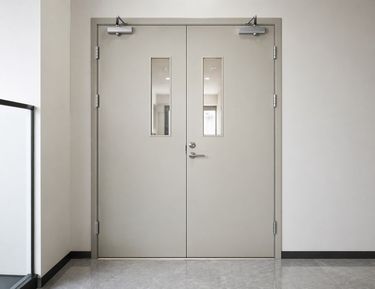
What Fire Rating Do I Need? (30 / 60 / 90 / 120 mins)
The short answer: the fire rating you need depends on building risk level, code requirements, and door location. In most commercial projects, 60-minute fire doors are the baseline, while 90–120 minutes are required for high-risk or critical separation zones.
Understanding fire door rating requirements is essential to avoid compliance issues and ensure real fire protection performance.
What Does Fire Door Rating Actually Mean?
A fire door rating indicates how long a door can withstand fire exposure while maintaining integrity and, in some cases, insulation.
For example, a 60-minute fire door is tested to resist fire for at least 60 minutes under controlled conditions.
These ratings are determined through standardized tests such as UL 10C or EN 1634-1, ensuring consistency across projects.
When asking what fire rating is required, the answer always depends on both regulation and application.
Fire Door Rating Chart by Application
A practical way to understand fire door rating requirements is by mapping ratings to real-world use cases.
- 30 min → Low-risk areas, internal corridors
- 60 min → Standard commercial buildings
- 90 min → High-risk zones, stairwells
- 120 min → Industrial or special hazard areas
This simplified fire door rating chart helps decision-makers quickly align ratings with building functions.
30 vs 60 vs 90 vs 120 Minute Fire Doors
Choosing between ratings is one of the most common challenges in how to choose the right fire door rating.
30 Minute Fire Doors
30-minute doors are typically used in low-risk environments such as small offices or internal partitions.
They offer a cost-effective solution while still providing basic fire protection.
When comparing 30 minute fire door vs 60 minute, the main advantage is lower cost and lighter construction.
60 Minute Fire Doors
60-minute fire doors are the most widely used option in commercial buildings.
They provide a balance between safety, cost, and compliance, making them suitable for corridors and general fire separation.
In many projects, 60 minutes is considered the minimum acceptable standard.
90 Minute Fire Doors
90-minute fire doors are designed for higher-risk areas such as stairwells, escape routes, and equipment rooms.
They provide extended protection, allowing more time for evacuation and fire control.
These doors are commonly required in high-rise or complex buildings.
120 Minute Fire Doors
120-minute fire doors are used in industrial facilities or areas with significant fire hazards.
They offer maximum fire resistance and are often specified for critical fire compartments.
Although more expensive, they provide the highest level of protection among standard ratings.
Factors That Determine Fire Rating Requirements
Several factors influence what fire rating is required for a specific project.
Building type, occupancy load, and fire risk level are primary considerations.
Door location is also critical—stairwells and escape routes typically require higher ratings than internal offices.
Additionally, local regulations and certification standards directly affect fire door rating requirements.
Material selection, including core structure and thickness, also plays a key role in achieving the required fire rating.
Understanding these factors ensures that fire doors are both compliant and effective.
Fire Rating Requirements by Code
Fire door rating requirements vary by region but follow similar principles.
In the US, ratings are defined through UL standards and building codes, which specify where each rating is required.
In Europe, EN standards classify fire doors using EI ratings, focusing on integrity and insulation performance.
Both systems aim to ensure that fire doors perform consistently under real fire conditions.
Aligning with regional standards is essential when determining what fire rating is required.
Common Mistakes When Choosing Fire Ratings
Many projects encounter issues due to incorrect fire rating selection.
One common mistake is choosing a rating based solely on cost rather than application needs.
Another is misunderstanding the difference between 30 minute fire door vs 60 minute, leading to under-specification.
Failing to match door ratings with building codes can also result in compliance failure.
Ignoring installation quality is another risk, as even certified doors can fail if installed incorrectly.
Avoiding these mistakes is critical for meeting fire door rating requirements.
How to Choose the Right Fire Door Rating for Your Project
Selecting the correct rating requires balancing safety, compliance, and budget.
Start by identifying the building type and risk level, then review applicable codes.
Use a fire door rating chart to align door ratings with specific areas.
Consult with suppliers or fire safety experts to confirm specifications.
It is also important to consider long-term performance, including durability, maintenance needs, and environmental conditions.
For example, doors in high-humidity or high-traffic environments may require more robust materials even if the fire rating is the same.
Additionally, coordination with other building systems—such as fire alarms and sprinkler systems—can influence overall fire protection strategy.
Proper integration ensures that fire doors function effectively within the entire fire safety system.
This structured approach simplifies how to choose the right fire door rating and reduces project risk.
Get Help Choosing the Right Fire Door Rating
Fire door selection can be complex, especially for large or international projects.
Working with experienced manufacturers helps ensure compliance with global standards and project requirements.
They can provide technical guidance on fire door structures, materials, and certification alignment.
If you are unsure about what fire rating is required, expert support can help optimize both safety and cost efficiency.
In addition, experienced suppliers can assist with documentation, testing reports, and certification verification, which are often required during project approval stages.
This level of support is particularly important for export projects or developments involving multiple regulatory systems.
Choosing the right partner also ensures that fire doors meet not only initial requirements but long-term performance expectations.
Conclusion
Choosing the correct fire rating is essential for both compliance and safety. Old To New provides certified fire door solutions designed to meet diverse rating requirements across commercial and industrial projects.

Contact
Beyond Protection, There's Peace of Mind.
© 2024 oldtonew Powered by ShopAstro