


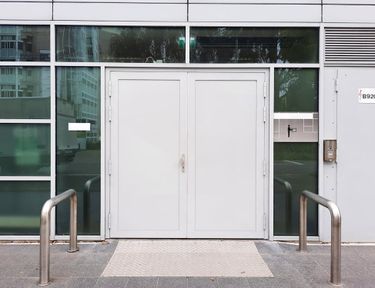
Fire Door Regulations for Commercial Buildings
Fire door regulations for commercial buildings define how fire doors must be tested, certified, and used to meet safety and legal requirements. In practice, compliance is not optional—fire doors without proper certification cannot be installed or approved in most commercial projects.
For contractors, developers, and importers, understanding fire door regulations for commercial buildings is essential to ensure project approval, safety performance, and market access.
What Are Fire Door Regulations?
Fire door regulations are standards that define the fire resistance performance, material requirements, and testing methods for fire-rated doors.
These regulations ensure that fire doors can effectively prevent fire spread and protect evacuation routes.
They also require that fire doors be tested as complete assemblies, including the leaf, frame, hardware, and sealing systems.
Why Fire Door Regulations Matter in Commercial Buildings
Commercial buildings have higher occupancy and stricter safety requirements. This makes fire door regulations for commercial buildings a critical part of project design.
Fire doors act as barriers that delay fire and smoke, helping protect both people and property.
Without proper certification, fire doors may fail inspection or be rejected during project approval.
Key Fire Door Standards and Codes Explained
Fire door regulations are enforced through certification systems. Each region has its own mandatory standards, which define whether a fire door can legally be used.
UL 10B / UL 10C – North American Certification
UL 10B and UL 10C are core fire resistance standards developed by Underwriters Laboratories.
UL 10B applies to swinging fire doors, while UL 10C covers additional types such as sliding or folding doors.
These standards test fire doors under controlled conditions to evaluate their ability to resist fire.
Fire doors without UL certification cannot be used in projects governed by UL standards, making it a mandatory requirement in North America.
BS /EN 1634-1 – European Fire Door Standard
BS /EN 1634-1 is the main European standard for testing fire door assemblies.
It evaluates complete door sets—including leaf, frame, hardware, and glazing—under fire exposure conditions.
The results are classified into EI ratings (such as EI30, EI60, EI90), representing integrity and insulation performance.
Without BS /EN 1634-1 certification, fire doors cannot meet CE marking requirements for EU and UK markets.
BS 476 Part 22 – UK Fire Resistance Testing
BS 476 Part 22 is a widely used UK standard for testing fire resistance of non-loadbearing elements, including fire doors.
It defines how doors perform under fire exposure and ensures they meet safety requirements.
This standard remains important for projects following traditional UK fire testing methods.
GB 12955 & 3C Certification – China Market Access
GB 12955 is China’s national standard for fire-resistant doors, defining requirements for materials, fire resistance, and smoke tightness.
3C certification is a mandatory conformity assessment system based on GB 12955.
Only fire doors that meet GB 12955 can obtain 3C certification, which is required for market entry in China.
Without this certification, products cannot legally be sold or used in Chinese construction projects.
CARB NAF – Low Emission & Indoor Air Quality
In addition to fire performance, environmental compliance is becoming part of fire door regulations commercial buildings in many markets.
CARB NAF (No Added Formaldehyde) certification ensures that fire doors meet strict low-emission standards.
This is especially important for indoor environments such as offices, hospitals, and schools, where air quality is a key concern.
Products without CARB compliance may face restrictions in environmentally regulated markets.
FSC Certification – Sustainable Material Sourcing
FSC certification ensures that wood used in fire doors comes from responsibly managed forests.
It includes both forest management certification and chain-of-custody tracking, ensuring full traceability from source to final product.
For projects with sustainability requirements, FSC-certified fire doors are often preferred or required.
Without FSC certification, products may not meet procurement standards in eco-conscious markets.
Fire Door Rating Requirements for Commercial Buildings
Fire ratings are a key part of fire door regulations for commercial buildings, determining how long a door can resist fire.
Common Fire Ratings Explained
Fire doors are typically rated for 20, 45, 60, 90, or 120 minutes.
Lower ratings are used for smoke control and low-risk areas, while higher ratings are required for critical fire separation zones.
These ratings are influenced by design factors such as materials and Fire Door Core Thickness Standards.
Fire Rating Requirements by Building Type
Different building types require different fire ratings based on risk level.
Commercial offices commonly use 60-minute doors, while hospitals and high-rise buildings often require 90–120 minutes.
Industrial environments may require the highest ratings due to increased fire hazards.
Fire Door Rating vs Wall Rating
A common mistake is assuming fire door ratings must match wall ratings exactly.
In reality, door ratings may be lower than wall ratings depending on code requirements.
Understanding this difference helps ensure compliance with fire door regulations commercial buildings.
Where Are Fire Doors Required in Commercial Buildings?
Fire doors must be installed in areas where fire containment is essential.
Typical locations include stairwells, corridors, elevator lobbies, equipment rooms, and fire-rated partitions.
They are also required between different fire compartments.
Correct placement is critical for meeting fire door regulations for commercial buildings.
Fire Door Components and Compliance Requirements
A fire door is a complete system rather than a single product.
It includes the door leaf, frame, hinges, seals, glazing, and hardware.
All components must be tested together under the same certification standard.
Using non-certified parts can invalidate the entire fire door assembly.
Fire Door Inspection and Maintenance Requirements
Fire door compliance continues after installation.
Regular inspections are required to ensure the door remains functional and compliant.
Key checks include door alignment, sealing performance, and hardware operation.
Proper maintenance ensures ongoing compliance with fire door regulations commercial buildings.
Common Fire Door Compliance Mistakes
Many compliance issues come from avoidable mistakes:
- Using fire doors without proper certification (UL, EN, or GB)
- Mixing certified and non-certified components
- Improper installation that voids certification
Another common issue is ignoring regional requirements, such as missing 3C certification for the Chinese market.
Avoiding these mistakes helps ensure smooth project approval.
Conclusion
Fire door regulations influence material selection, supplier choice, and project planning.Choosing certified products early reduces the risk of delays and compliance failures.
Working with manufacturers who understand global certification systems ensures smoother execution.Old To New provides fire door solutions that meet UL, EN, BS and other standards, helping ensure reliable performance across global commercial projects.

Contact
Beyond Protection, There's Peace of Mind.
© 2024 oldtonew Powered by ShopAstro